
Someone would have to take a gun to my head to … turn over the copyright’
Chris Outcalt
June 17, 2007, 2:00 a.m. ET
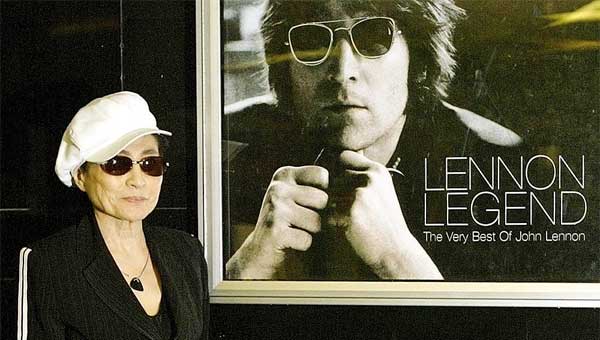
Yoko Ono is pictured next to a poster of John Lennon at a 2003 London premiere of a DVD containing songs and some previously unreleased footage and home movies.
Imagine a film with scenes of John Lennon sitting on his bed, acoustic guitar in hand, crafting the music and lyrics to a song that would eventually be released as the title track on his album “Mind Games.”
Imagine Lennon rehearsing before an appearance on the BBC show “Top of the Pops,” getting ready to perform his eventual hit “Instant Karma” for the first time.
The scenes are part of footage gathered by Yoko Ono’s former husband, Tony Cox, during four days in 1970. And only a handful of people may ever see them.
Cox got approval to record video of Lennon and Ono, but never released anything. In 2000, three Boston-area businessmen say they purchased both the copyright and footage from Cox for about $1 million.
Since acquiring the film, Rye resident Ray Thomas, John Fallon and Robert Grenier — partners in World Wide Video LLC — have edited it down to a two-hour documentary they had intended to debut at Berwick Academy in March.
But the film was canceled the day it was scheduled to be shown after Ono contacted the school and maintained she had a copyright interest in the footage and had not authorized the viewing. Without an artist release from Ono, the company cannot profit from showing the film, but it can be screened for free — which they intended to do at Berwick Academy.
Thomas, Fallon and Grenier, however, still contend they own the footage and would never have agreed to transfer the copyright to Ono.
They maintain the film was stolen by a former employee. And they have been in and out of courts for seven years attempting to prove it. Recently, they filed a criminal complaint with the Massachusetts Attorney General’s Office alleging the employee and his lawyer forged their signatures and sold the footage and copyright to Ono.
Get the Daily Briefing newsletter in your inbox.
Start your day with the morning’s top news
Delivery: Daily
Your Email
The trio has also settled a civil lawsuit against the former part-time employee. As part of the settlement, John Messina, whose last known address was 179 Stage Road in Hampstead, agreed to pay the company $15,000, but did not admit guilt to the allegations contained in the lawsuit.
World Wide Video attorney Ronald Bienstock, of the New York City firm Bienstock & Michael, P.C., said he’s had myriad discussions regarding the film with Ono’s attorneys.
Ono’s lawyer Peter Shukat, at the New York City firm Shukat Arrow Hafer & Weber L.L.P., declined comment.
But Bienstock said, “The disputes center around usage and exploitation of the film. The one thing that is clear is that (Thomas, Fallon and Grenier) are the owners of the film.”
On Tuesday, June 5, Messina was scheduled to appear at a hearing in Plaistow District Court concerning his failure to pay the $15,000 settlement to World Wide Video. He didn’t show.
According to the lawsuit filed by the company in Middlesex County Superior Court in Massachusetts, Messina took the Lennon tapes in March 2000, and failed to return them after several requests.
World Wide Video partner Grenier said he met with Messina early in April of that year and, according to court documents, “Messina indicated that if he were paid $50,000 together with 2 percent of the proceeds of any sale of the tapes, he could ‘put the word out on the street’ and could secure the return of the tapes.”
However, according to court documents later filed by Messina’s lawyer, John Buck, Messina maintained he never had the tapes in his possession and never demanded payment of $50,000.
No criminal charges have been filed against Messina. Attempts to reach him for comment regarding the settlement and court appearance were unsuccessful.
According to the Hampstead town assessor’s office, Messina owns property at 179 Stage Road, but the listed phone number for the residence has been disconnected.
The original footage of Lennon was captured by Cox on 24 original black-and-white tapes. He also made copies of the film on 11 three-quarter inch tapes and six VHS tapes.
In 2000, Fallon acquired all three copies from Cox — which they later transferred to World Wide Video. In the lawsuit, the company alleges both the 24 original tapes and the 11 three-quarter inch tapes were stolen by Messina.
It wasn’t until 2004, Fallon said, that the 11 three-quarter inch tapes were returned by a third party, whom he declined to identify. The 24 original tapes recorded by Cox were still missing and, in April 2005, said Fallon, World Wide Video was contacted by a representative of Yoko Ono who said she had purchased the original footage and was also in possession of the corresponding copyright.
The most important part of the deal he made with Cox, said Fallon, was securing the film’s copyright.
“Someone would have to take a gun to my head to make me turn over the copyright,” Fallon said.
In March 2006, Fallon and Grenier filed a formal complaint with the Massachusetts Board of Bar Overseers, alleging Messina’s lawyer notarized forged copes of their signatures that allowed the transfer of the film’s copyright to Ono.
In a document sent to the Massachusetts Bar board on March 31, 2006, Messina’s lawyer, John Buck, stated he did not “willfully, intentionally or fraudulently notarize any signatures.”
According to the document, Buck only approved the signatures after requesting photo identification from the individuals who claimed to be Fallon and Grenier.
“Documents were placed before me which memorialized an agreement between the gentlemen standing before me in my office,” Buck said in the document. “And what appeared to be valid Massachusetts licenses were provided to me substantiating the identity of those individuals before me who in turn signed the documents in question.”
Attempts to reach Buck — whose last known address was 28 West Meadow Mill Road in Haverhill, Mass. — for further comment were unsuccessful.
After learning Berwick Academy had canceled the film’s screening in March, World Wide Video partner Thomas said he was most upset with the fact that the students wouldn’t be able to see the movie.
“The entire student body lost out on an opportunity to see what it was like to live in the ’60s and to see John Lennon playing his guitar in his apartment,” Thomas said at the time.
The trio continues to pursue any means to ensure they can show the film for free at schools and other venues across the country.
“We lost close to everything we own to buy this movie,” Thomas said. “It’s important to me that we prosecute the people that committed the crimes.”
Leave a Reply